
Fascinate on Fascia
For an audio version of this article, click here.
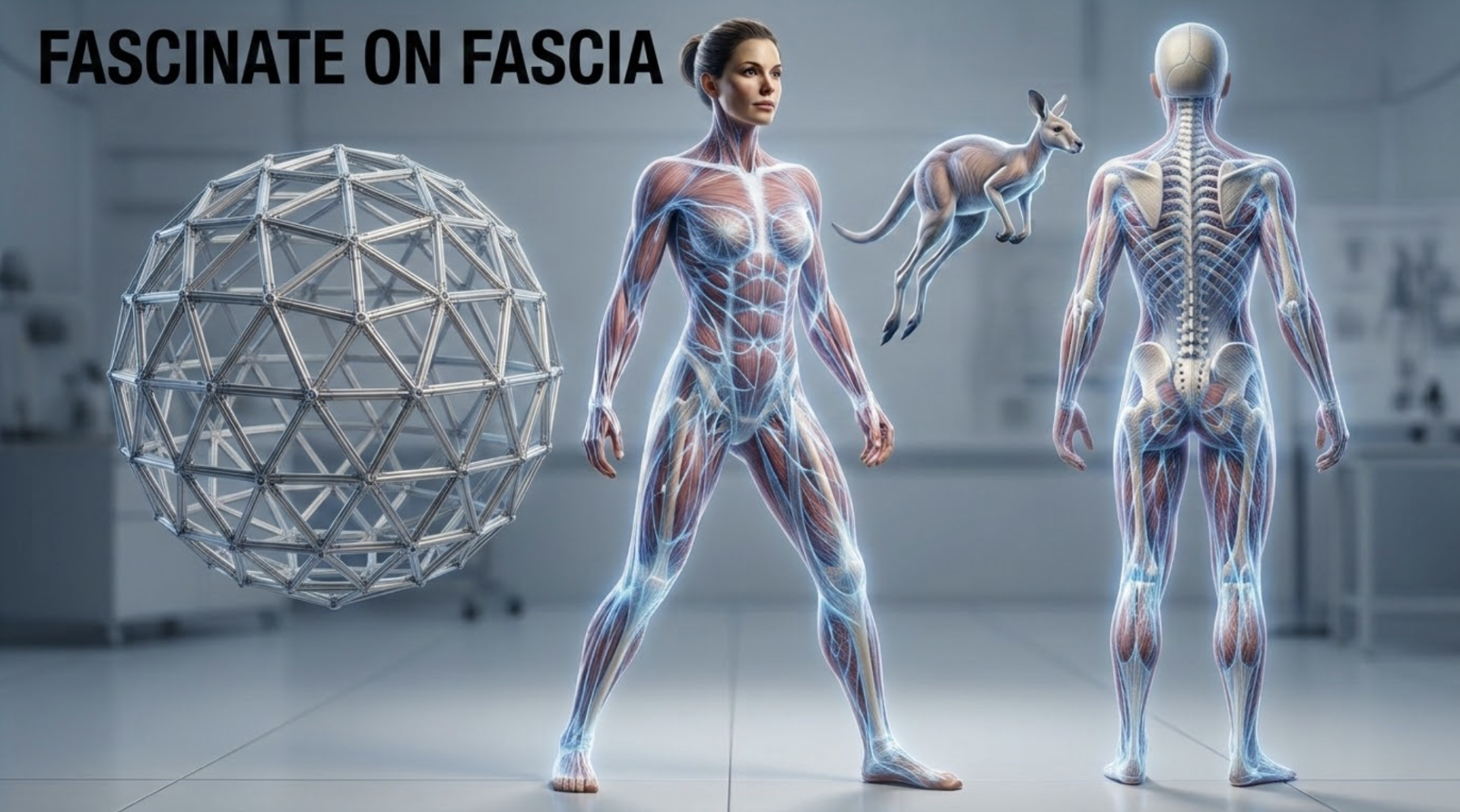
"You never change things by fighting the existing reality. To change something, build a new model that makes the existing model obsolete." - Buckminster Fuller
For decades, traditional anatomy taught us to view the human body like a high-school skeleton with muscles strapped onto it. It was suggested that bones stack up like bricks to support us, and individual muscles pull on those bones like isolated cables in a simple lever system.
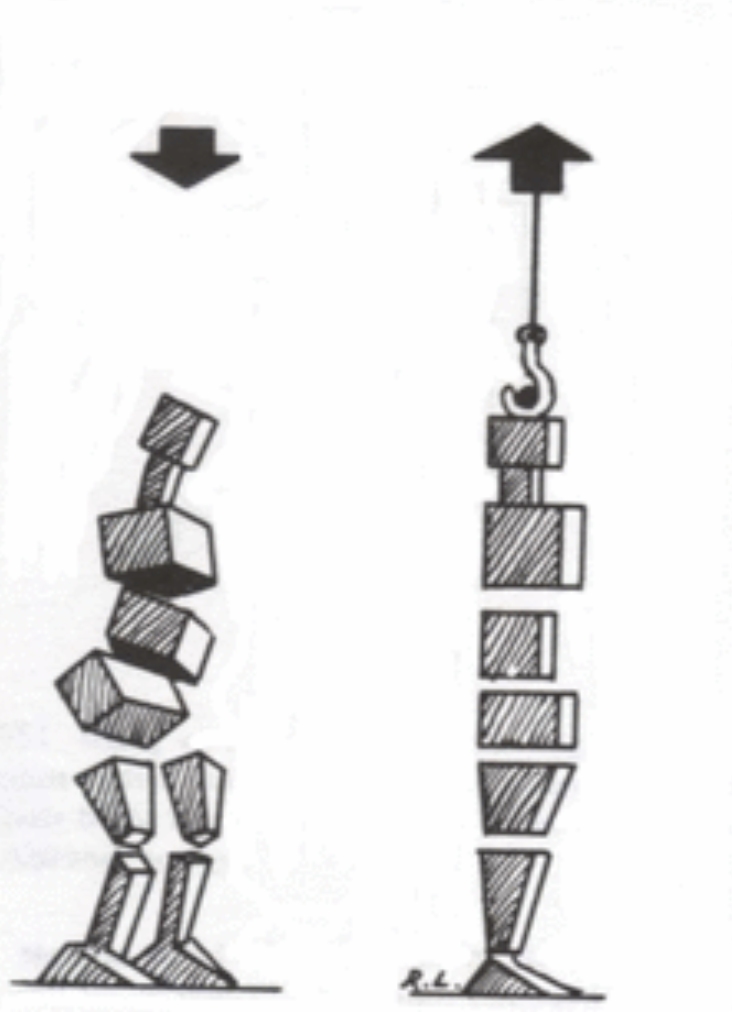
It’s a tidy theory, and when we are lying on a table and we isolate certain joints it indeed works…however when we stand up and engage with life, and play in the field of gravity working with ground reaction forces, mass and momentum, this perspective of biology and its wondrous mechanics is utterly incomplete.
To make sense of how our bodies actually move, perform, and adapt, we have to look past the isolated muscles and bones to what we historically just called "connective tissue" - or what modern movement science now calls “fascia”.
Fascia is the uninterrupted, three-dimensional liquid-crystalline web wrapping and penetrating every muscle, bone, nerve, and organ in your body. Literally connecting your nose to your toes.
Fascia is the living architecture of your body, and understanding how it works changes everything.
"Under the microscope, there are no straight lines, no isolated muscles, and no empty spaces. There is only a continuous, chaotic, and beautiful dynamic web." - Dr. Jean-Claude Guimberteau. Hand Surgeon & Micro-Cinematographer
🏗️ Biotensegrity: The Architectural Revolution
"Synergy is the only word in our language that means behavior of whole systems unpredicted by the behavior of any of its parts operating separately." - Buckminster Fuller

In standard mathematics, 1 + 1 always equals 2. But when we look at living biology, we encounter a playful yet profound rule known as synergistic math: 1 + 1 = 3
Where does that mysterious extra "1" come from? It represents the relationship between the parts. When independent components connect into a single, continuous system, they create an emergent property - a result far greater than the simple sum of its parts. That is the magic of synergy and of the human body!
To understand how your body uses synergy to move, cushion impact, and carry weight, we have to borrow a breakthrough architectural principle from futurist Buckminster Fuller: Tensegrity (tensional integrity).
Traditional engineering structures rely on gravitational compression bricks stacking on bricks, pressing down. But Fuller pioneered structures that stay upright through continuous tension and local compression. The rigid struts inside a tensegrity model don't actually touch one another; they float gracefully inside a perfectly balanced, taut sea of surrounding cables.
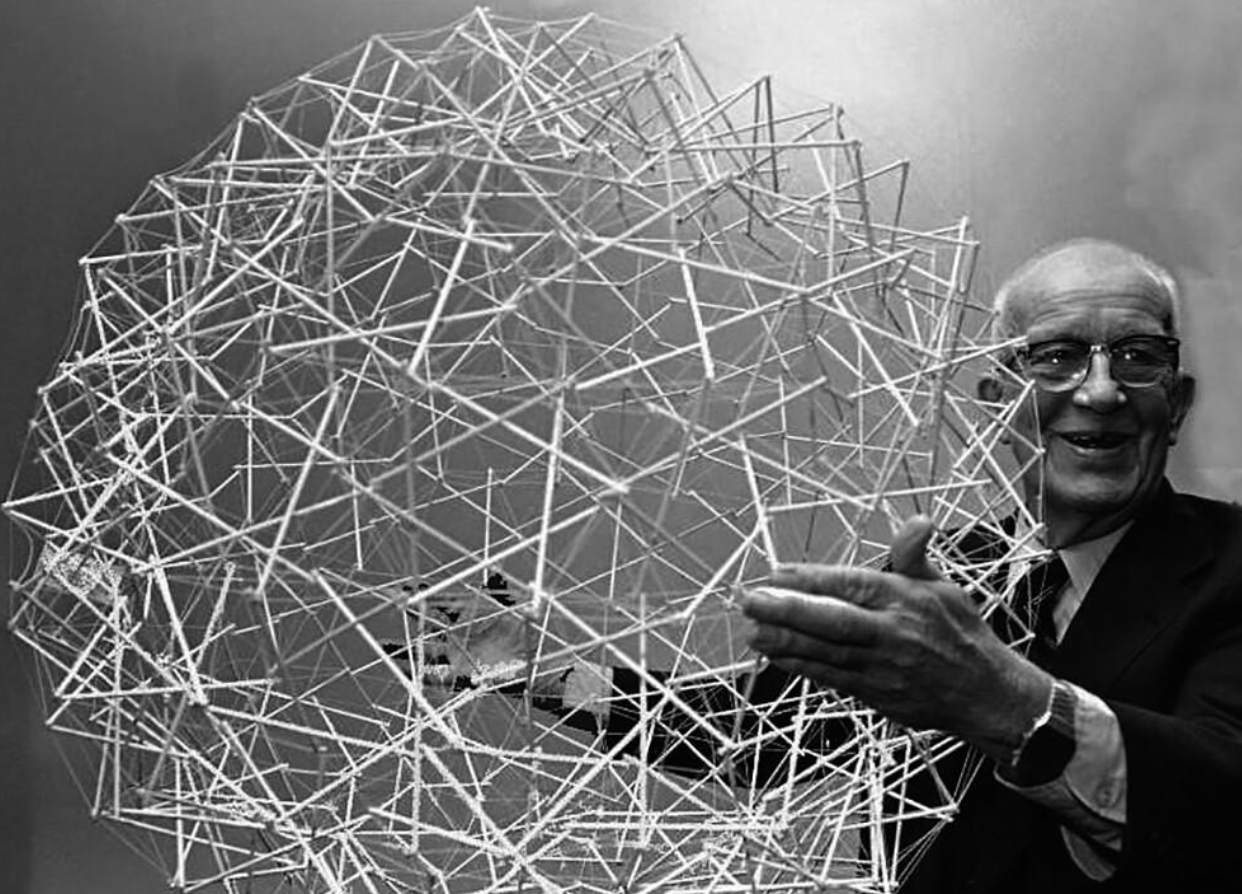
Buckminster Fuller (1895–1983) Architect, Engineer and Futurist with a Tensegrity structure
When orthopedic surgeon Dr. Stephen Levin applied this exact principle to human anatomy, he birthed a whole new field: Biotensegrity.
Your bones are not architectural pillars stacked on top of one another like building blocks. If they were, your lower back would collapse under the weight of your head the moment you leaned forward - let alone trying to explain how a giraffe could ever lean its six-foot, 200+ kg neck down to drink water using the classical lever-and-fulcrum model first proposed by Giovanni Alfonso Borelli in 1680 (De Motu Animalium).
Under Borelli’s 340-year-old lever math, the torque on a giraffe’s lower neck vertebrae would physically snap its bones. Which leaves us with a brilliant realization: either Borelli left us a 400 year old biological puzzle, OR we just haven't tried hard enough to write a better working biological equation to explain how living bodies actually bear and transfer load.
Biotensegrity offers a solution by showing that load is distributed globally across the fascial net rather than concentrated locally at the joint "fulcrum."
As structural pioneer Thomas Myers famously mapped out in his Anatomy Trains framework, our muscles do not function as isolated units. They operate along long, interconnected myofascial meridians. You aren’t a collection of 600 separate muscles; you are one single muscle distributed across 600 fascial pockets.
🛠️ Practical Application: The 4 Pillars of Fascial Health and Fitness
In their landmark book Fascial Fitness, Dr. Robert Schleip and Johanna Bayer outline how to train, rebuild, and rehydrate this vital tissue matrix. To build elastic, healthy, resilient fascia whose layers are able to slide and glide past each other (like your shirt does under your jacket) and efficiently share forces throughout the body, your routine should incorporate these four core elements:
1. Rebound Elasticity (The "Catapult Effect")
Unlike muscle, which relies on metabolic energy, fascia acts like a natural rubber band that stores and returns kinetic energy. Incorporate light bouncing, skipping, elastic rebounds, and swinging movements (a correctly weighted smooth and springy Kettlebell swing is one example) to train the springy recoil properties of your tendons and deep fascial sheets.
As a proud Australian I am going to build an example and call it “The Kangaroo Effect”
Did you know a Red Kangaroo can leap up to 10 meters in a single bound? Not by exhausting its leg muscles, but by loading its massive Achilles tendon like a heavy-duty slingshot.
We humans share this exact "Catapult Mechanism." While chimps have short tendons built for climbing, we evolved long Achilles tendons and a thick, arched plantar fascia that stretch and recoil with every stride, returning up to 50% of our energy for free!
Move over Africa! Perhaps the 'missing link' isn't some ape-like creature, but a kangaroo… making Australia the true cradle of humankind!
2. Multi-Directional Fascial Lengthening
Static and many traditional linear stretches primarily lengthen (and load) tissues along a single plane of motion. However, fascia is an interconnected, multi-directional web that thrives on long, multiplanar, three-dimensional movement. Incorporate lunges, reaches, and stretches that add appropriate rotation (for you), side-bending, and subtle angle shifts to feed tension across diverse vectors (lines of force) and whole myofascial lines.
3. Dynamic Hydration ("Squeezing the Sponge")
Fascia is essentially a collagen rich, tension transmitting, hydraulic sponge filled with a gel-like fluid containing Proteoglycans (protein-sugar molecules that act like water magnets) and hyaluronic acid (long-chain molecules that act as a friction reducing biological lubricant).
Chugging water alone won't hydrate a glued, stagnant fascial tissue layer. You must use compression - through foam rolling, manual therapy, and adequate and appropriate movement variation, to physically squeeze old, stagnant fluid out of the tissue matrix. When you release the pressure, the tissue acts like a fresh sponge, rapidly pulling clean, mineralized fluid back in.
4. Sensory Refinement (Proprioception)
Fascia is packed with nerve endings and mechanoreceptors (like Pacinian corpuscles, Ruffini endings, and Golgi endings) that constantly inform your brain where your body is in space. Regularly practice variable speed, precise, novel movements to refine your sensory awareness and keep your body's internal GPS pin-sharp.
To serve as a combined practical example, at Joint Dynamics we often incorporate these four core elements as part of your warm-up or movement prep
💧 Fueling the Matrix: Nutritional Architecture
To rebuild resilient collagen strands, your fibroblasts require specific nutritional raw materials:
Collagen Building Blocks: Amino acids such as proline, glycine, and lysine provide the raw structural material to weave new fascial fibres.
Focus on bone broths, slow-cooked meats, wild-caught fish, or explore supplementing with collagen peptides.
Vitamin C: The essential cofactor for collagen synthesis. Without adequate Vitamin C, your body cannot cross-link collagen fibres efficiently.
Regularly consume high Vitamin C containing foods such as guavas, yellow or red capsicums, kiwifruits and citrus fruits
Trace Minerals: Copper and Zinc are vital for tissue remodelling, elastic repair, and maintaining extracellular matrix health.
Treat yourself to some oysters, or beef liver for rich sources of the above. Pumpkin Seeds (Pepitas) are an excellent plant source and dark chocolate (above 70%) deserves a mention as well!
🧠 Does Fascia "Store" Emotions? Science, Somatics, and Discernment
In bodywork and modern wellness circles, you will frequently hear the claim that "trauma and emotions are stored directly in your fascia." But what does the science actually say?
When evaluated through rigorous peer-reviewed biology, the idea that physical connective tissue acts as a literal hard drive for specific emotional memories has very low scientific plausibility. Much of the popular cultural imagery surrounding "structured tissue memory" or "water memory" can be traced back to pseudoscientific concepts popularized by authors like Masaru Emoto in The Hidden Messages in Water. While captivating and romantic as poetry, these ideas lack empirical validation in human physiology.
However, we must approach the human body with deep reverence and humility. There is a vast amount we understand about biology, and an equally vast ocean we have yet to map.
While fascia may not "store" an emotion like a file on a computer, somatic release and the mind-body link are undeniably real:
Consider how quickly an emotional state triggers a physical response: a gut-wrenching moment causes "butterflies in the stomach," or sudden awe causes the arrector pili muscles to contract, making your hairs stand on end.
There is no doubt emotional stress alters autonomic nervous system tone, causing chronic guarding patterns that change body tissue fluid dynamics, increase muscular holding or tension, and alter fascial viscoelasticity over time.
A Note on Discernment
When navigating claims about "fascial emotional release," use healthy common sense:
Beware Marketing Ploys: Be skeptical of aggressive marketing that promises to "wipe your cellular trauma" or “release trapped emotions” for a high fee based on thin scientific evidence.
Respect Ethical Experience: Do not discount the vast anecdotal evidence from highly skilled, ethical manual therapists. When an authentic therapeutic interaction occurs, the human nervous system often feels safe enough to let go of long-held physical guarding patterns, resulting in a genuine, felt emotional release.
✨ Looking Ahead with Wonder
As imaging technology advances, our understanding of human movement is shifting from a mechanical view of isolated parts to a dynamic and holistic appreciation of fluid wholeness. Your fascia is a living, breathing, sensory matrix that records how you move, how you rest, and how you can adapt to fit your life incorporating your goals, needs, and desires while maintaining the capacity to deal with the odd emergency every now and then.
By nourishing your fascia-filled body with the understanding we currently have (shared to the best of my ability above), combined with a healthy dose of critical discernment toward what the online wellness circus feeds you to excite or scare you into action, you give your body the structural freedom to remain vital, elastic, and dynamic for your life.
"Maddest of all is to see life as it is, and not as it should be!" - Miguel de Cervantes (Don Quixote)
