
If you would like an audio version of this article to listen on the go, click here.
"Nothing in biology makes sense except in the light of evolution." — Theodosius Dobzhansky
Spend thirty seconds scrolling through health media today, and you will quickly see cortisol often portrayed as wellness enemy number one. It is easy to understand why: condensing complex human endocrinology into a thirty-second sound bite naturally forces creators to paint with broad strokes, turning nuanced physiology into simple heroes and villains. Cortisol (by the way) is an essential hormone, the body’s primary stress hormone. It is not a design flaw in your biology, nor is it a toxic metabolic byproduct waiting to be purged by a detox tea or essential oils; it is a key component of a sophisticated survival mechanism.
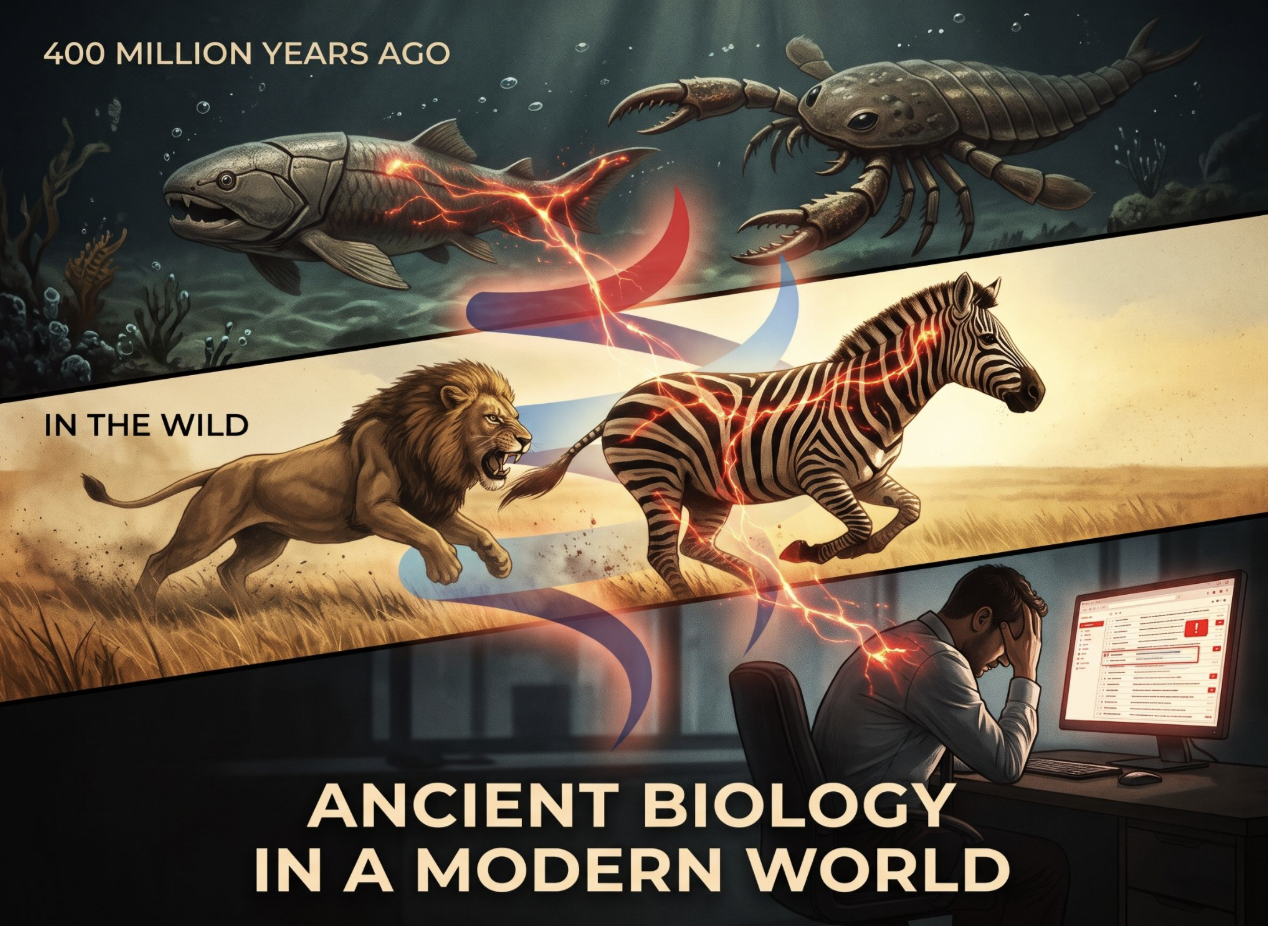
In fact, this molecule is so foundational to life that it predates humanity by hundreds of millions of years. As Stanford neurobiologist Dr. Robert Sapolsky frequently points out, the stress response is over 400 million years old. A primitive, armored jawless fish evading an apex sea scorpion in a prehistoric Paleozoic sea, a zebra frantically outrunning a lion on the savannah in Africa, and a modern professional sedentarily staring down an overwhelming inbox all deploy virtually the same neuroendocrine cascade - the body’s primal “fight or flight” response.
The current species of human is known as Homo sapiens (actually, we are Homo sapiens sapiens), which translates from Latin to "wise human.” In light of the conundrum explored in this article, and the “penguin in the desert” mismatch between our DNA and our modern environment, that translation may be up for debate!
In a nutshell, the biochemical machinery that immediately spikes your pulse, sharpens your senses, and floods your bloodstream with glucose for two minutes of explosive physical violence to save your life, take a life (so you may eat), or escape (so you might not be eaten) was engineered in dynamically dangerous waters hundreds of millions of years before we Homo sapiens sapiens learned to keep the “fight or flight” response running while lying completely motionless in a safe bed at 2:00 AM, aggressively re-litigating an awkward remark made at work last Tuesday!
"There are some four million different kinds of animals and plants in the world. Four million different solutions to the problems of staying alive." - Sir David Attenborough (Life on Earth)
So… What actually is Cortisol and what does it do?
At its core, cortisol is a steroid hormone classified as a glucocorticoid, synthesized on demand from cholesterol inside your adrenal glands (the two small, triangular glands perched on top of your kidneys).
For generations, the inner workings of the adrenal glands remained an anatomical mystery. That changed throughout the 1930s when American chemist Dr. Edward C. Kendall at the Mayo Clinic and Swiss chemist Tadeus Reichstein independently set out to isolate the active substances within the adrenal cortex. Laboriously processing tons of glandular extracts, they separated and crystallized a sequence of distinct compounds, labeling them alphabetically. Among them, Kendall identified Compound F - the exact molecule we know as cortisol. Today, synthetic derivatives of cortisol - prednisone, dexamethasone, and hydrocortisone (hydrocortisone is the name given to the synthetic equivalent of cortisol) remain among the most widely used, life-saving pharmaceuticals on the planet, quelling severe asthma attacks, treating septic shock, and preventing organ rejection in transplant recipients.
In 1950, Kendall, Reichstein, and Mayo physician Dr. Philip Hench were jointly awarded the Nobel Prize in Medicine for their pioneering work deciphering the structure and biological effects of these adrenal hormones.
What Cortisol Does: The Master Dispatch Coordinator
Cortisol is an indispensable hormone in human physiology. Without baseline cortisol, your body could not maintain vascular tone, mobilise fuel between meals, or keep inflammation in check.
Instead of viewing it as an emergency panic button, it is far more accurate to think of cortisol as a biological dispatch coordinator. It routes vital resources wherever your body needs them most:
Fuel & Metabolism: It helps maintain steady blood glucose by prompting the liver to make glucose (gluconeogenesis) and mobilising stored energy during periods of fasting, illness, exertion, or elevated demand.
Cardiovascular Tone: It supports normal blood pressure and heart function by sensitising blood vessels to signals like adrenaline, playing a part in preventing your blood pressure from dropping whenever you stand up.
Immune Regulation: Cortisol helps regulate inflammation and immune activity, but its impact depends entirely on timing, dose, and context:
In the short term: Cortisol acts as a vital, temporary brake on the immune system, preventing healthy tissue damage by keeping acute inflammatory responses proportional and controlled.
Under prolonged excess: Sustained high levels lose this protective balance. Over time, chronic stress suppresses immune function - impairing your body’s ability to mount timely defenses against everyday infections, slowing tissue repair, delaying wound healing, and putting long-term biological maintenance on hold. PLUS chronic stress, leading to chronically elevated levels of cortisol, encourages central fat storage - A bigger belly.
"Visceral fat isn't just inert storage; it is an active endocrine tissue. Cortisol encourages fat accumulation in the abdomen, which in turn fuels systemic inflammation and metabolic strain."
— Dr. Bruce McEwen, Protective and Damaging Effects of Stress Mediators
The Integrated System: Why Cortisol Never Acts Alone
Crucially, cortisol does not decide to act on its own. It is simply the final chemical messenger in an integrated neuroendocrine circuit known as the Hypothalamic-Pituitary-Adrenal (HPA) axis.
Long before a single drop of cortisol enters your bloodstream, your brain makes an appraisal:
The Smoke Alarm (The Amygdala): Deep within the brain, the amygdala acts as your primary threat-detection radar. It constantly compares incoming sensory information against stored emotional memories to determine whether a situation represents danger.
The Rational Brake (The Prefrontal Cortex): Your prefrontal cortex, the seat of executive function, reasoning, and context, evaluates the threat and attempts to apply the brakes: “Is this situation actually going to hurt me, or is it just uncomfortable, OR is it an irrational thought?”
The Shifting Threshold: The tipping point for what sets off this alarm is not fixed. It is shaped by past experiences, learned conditioning, and, crucially - how often we mentally replay those experiences. Because the brain cannot easily distinguish between a physical event and a vivid, repetitive thought, habitual rumination trains the amygdala to become hyper-sensitized. Over time, its trigger threshold drops: the biological smoke alarm begins sounding off not just for fires, but for steam, minor friction, or tomorrow's imagined possibilities.
Once that alarm rings, the relay fires with rapid precision:
The brain responds to the demand: The brain’s internal regulator (the hypothalamus) receives the signal from the amygdala and releases Corticotropin-Releasing Hormone (CRH).
The signal is relayed: The central hormonal relay at the base of your brain (the pituitary gland) detects that alert and releases Adrenocorticotropic Hormone (ACTH) into the bloodstream.
The adrenals take action: The outer layer of your adrenal glands (the cortex) receive the chemical command and synthesize cortisol to adjust energy availability, maintain vascular tone, and modulate immune activity.
This communication loop does not just wait around for crises. Beyond acute challenges, this entire system manages your daily circadian rhythm. In a (generalised) healthy biological pattern, cortisol naturally rises across the morning to mobilise energy, and play its role in establishing daytime alertness, before steadily tapering downward later in the day to reach a trough near midnight, opening the physiological window for life enhancing, deep, restorative sleep.
The Double-Edged Gift of Being a Doubly Wise Human
In acute bursts, cortisol is a lifesaver. We see its physical boundaries in ultra-endurance athletes: pushing through a 100-mile trail run demands sustained cortisol output, but without proportional refueling and rest, the system eventually tips into neuroendocrine exhaustion and breakdown.
Yet for most of us, chronic cortisol elevation isn’t driven by running across mountain ranges. It is driven by our thoughts while sitting completely motionless.
Herein lies both the wonder and the vulnerability of being Homo sapiens sapiens ("doubly wise humans"): our gift of metacognition allows us to plan, reminisce, imagine, and connect. But because the brain cannot distinguish a vivid, repetitive worry from an immediate physical threat, we can literally think ourselves into survival mode. When that ancient alarm never turns off, (as discussed) chronic cortisol elevation exacts a well-documented biological toll:
Cardiometabolic Strain: Sustained elevation alters insulin sensitivity, promotes visceral fat storage around vital organs, and keeps vascular tone high—placing continuous strain on your cardiovascular system.
Immune Suppression: Prolonged excess blunts defenses against everyday pathogens while slowing tissue repair and wound healing.
Sleep & Cognitive Fatigue: Flattening your circadian curve erodes deep, restorative sleep - locking the brain into a cycle of daytime fog and late-night hyper-vigilance.
Our modern environment magnifies this evolutionary mismatch. Historically, our homes served as physical sanctuaries from external threats. Today, the "predators" ride inside our pockets. As social psychologist Jonathan Haidt highlights in The Anxious Generation, smartphones function as an omnipresent portal, letting competition, demanding inboxes, and global noise breach what was once a quiet refuge. In many ways, our phones mirror our relationship with cortisol: in brief, intentional bursts, both are remarkable tools that enhance our lives. In an unbuffered, 24/7 stream, both quietly erode our resilience.
What You Can Do: Practical Habits for Cortisol Regulation
We cannot eliminate the demands of modern life, but we can actively build biological shock absorbers. Here is how you can steer your cortisol curve back into balance:
1. Anchor Your Circadian Architecture (Sleep)
As sleep scientists emphasize, sleep and cortisol have an intimate, reciprocal relationship. Elevated evening cortisol erodes slow-wave deep sleep; poor sleep, in turn, elevates baseline cortisol the following day.
Morning Photons: When possible step outside within 30 to 60 minutes of waking for 10 to 15 minutes of natural sunlight. This helps trigger a healthy morning cortisol peak and sets your internal biological timer for evening melatonin production.
5 minutes is better than nothing, just be off your phone and open your posture to the sun
The Evening Unwind Buffer: Create a 60-minute transition zone before bed. Dim overhead lights, silence work notifications, and keep your bedroom dark and cool (around 18°C). Dropping your core body temperature signals your nervous system that it is safe to power down.
2. Interrupt the Reactive Circuit (Breath & Mind-Body Awareness)
Real-time stress mitigation is about creating a bridge between the conscious mind and autonomic nervous system. As physician and author Dr. Gabor Maté emphasises in his work on mind-body health, chronic stress often accumulates because modern life trains us to disconnect from our physical signals, ignoring internal tension until it manifests as physiological exhaustion or disease. Interrupting that reactive spiral requires tuning into somatic awareness and using your breath to actively signal safety back to the brain.
Extended Exhalation (The Nervous System Reset): The fastest way to tell your body it is safe is to make your exhale longer than your inhale. Inhaling gently lifts your heart rate, while a long, slow breath out stimulates the vagus nerve, signalling your system to switch into "rest and digest" mode. Try inhaling silently through your nose for 4 seconds, then exhaling smoothly for 6 to 8 seconds. Doing this for just two minutes can (with practice) rapidly slow your pulse and settle your body.
Somatic Self-Observation: As Dr Gabor Maté highlights, stress always leaves a physical footprint. Practice noticing where it lands in your body - a clenched jaw, hitched shoulders, or shallow breathing. Rather than fighting those physical signals, simply recognise them with curiosity and use your exhale to help those muscles soften and let go.
"Don't let how you feel dictate how you breathe; rather, let how you breathe dictate how you feel."
3. Use Exercise as Stress Inoculation
While exercise causes a brief, healthy spike in cortisol, that controlled physical challenge can also act like a biological vaccine against psychological stress:
Recalibrating the Amygdala: By exposing your body to physical stress (exercise) coupled with appropriate recovery in a safe environment, you train the Amygdala (your brain's threat-detection radar) to stay grounded under physiological stress, which can lead to lowering your baseline resting cortisol throughout the day.
Brain Protection (BDNF): Dynamic exercise stimulates the release of Brain-Derived Neurotrophic Factor (BDNF) - often called "fertilizer for the brain." BDNF promotes neuroplasticity and protects neurons in the hippocampus against cortisol-induced dendritic shrinkage, helping safeguard your memory, mood, and cognitive resilience.
Movement Snacks: If you sit for prolonged hours, take 2-minute walking or mobility breaks every 90 minutes. Brief physical effort burns through the glucose mobilised by cortisol completing the evolutionary stress response loop as nature intended. Simultaneously, movement coupled with nasal breathing prompts your blood vessels to release nitric oxide, widening arteries to deliver an immediate surge of oxygenated blood to the brain to clear mental fog.
4. Stabilize Your Metabolic Fuel (Nutrition)
Metabolic volatility is interpreted by the body as a physiological emergency.
Flatten the Glucose Rollercoaster: Sharp blood sugar crashes trigger adrenaline and cortisol spikes to force glucose back into the bloodstream. Eating nutrient dense whole-food meals rich in protein, dietary fibre, and healthy fats keeps blood sugar steady and prevents diet-induced stress spikes.
5. Worth Exploring: Targeted Botanical Support (Ashwagandha)
When fundamental sleep, exercise, and nutrition habits are established, targeted adaptogens or supplements can offer additional support.
What the Evidence Says: Multiple randomized controlled trials and meta-analyses confirm that standardised Ashwagandha root extract (Withania somnifera) can help modulate the HPA axis, reducing serum cortisol levels by roughly 14% to 28% and lowering perceived stress scores.
The Context: Ashwagandha is not a silver bullet, nor will a highly diluted tea bag undo chronic burnout. However, as a high-potency, standardised supplement used alongside foundational lifestyle habits, it is a scientifically backed tool worth discussing with a practitioner.
A Quiet Reality Check: Grace in a High-Pressure World
Let’s step back from the biochemistry for a moment.
Modern life is undeniably demanding. Between balancing family responsibilities, fulfilling career targets, managing finances, and navigating life in a fast-paced city, feeling overwhelmed is not a sign of personal failure - it is a normal human response to a high-demand environment.
To make matters worse, we are constantly surrounded by a marketing culture designed to weaponise our normal insecurities - telling us we aren't productive enough, lean enough, or calm enough, often to sell us quick fixes.
If you are feeling, and managing, the weight of daily expectations right now: you are doing remarkably well.
To unwind chronic stress and its effects, be patient with your biology. You do not need an immaculate daily routine or a “stress free” life to cultivate health. Transformation happens through small, repeatable acts of care: prioritising sleep, taking a conscious breath, staying hydrated, eating nourishing food, frequently moving your body, and having meaningful interactions with friends and, or family.
Looking Out for Yourself and Others
While daily stressors respond well to lifestyle adjustments, severe emotional pain, trauma, and deep burnout are very real. These are not things you are expected to simply "think away" or solve with a wellness habit.
If your situation feels insurmountable, reaching out for support is a profound act of courage. Whether that means speaking to a qualified psychologist, connecting with accessible community mental health services and public support helplines, or simply opening up to a trusted friend or family member, please remember you do not have to carry the weight alone. Keeping an eye on those around us and offering a listening ear is often the most vital support system we have.
Harmonising with our ancient biology is not about achieving perfection; it is a lifelong practice of gentle awareness and self-compassion. As the Buddha observed:
"Nothing can harm you as much as your own thoughts unguarded; and nothing can help you as much as your own thoughts trained and directed."
