
The Truth About Testosterone and Building Muscle
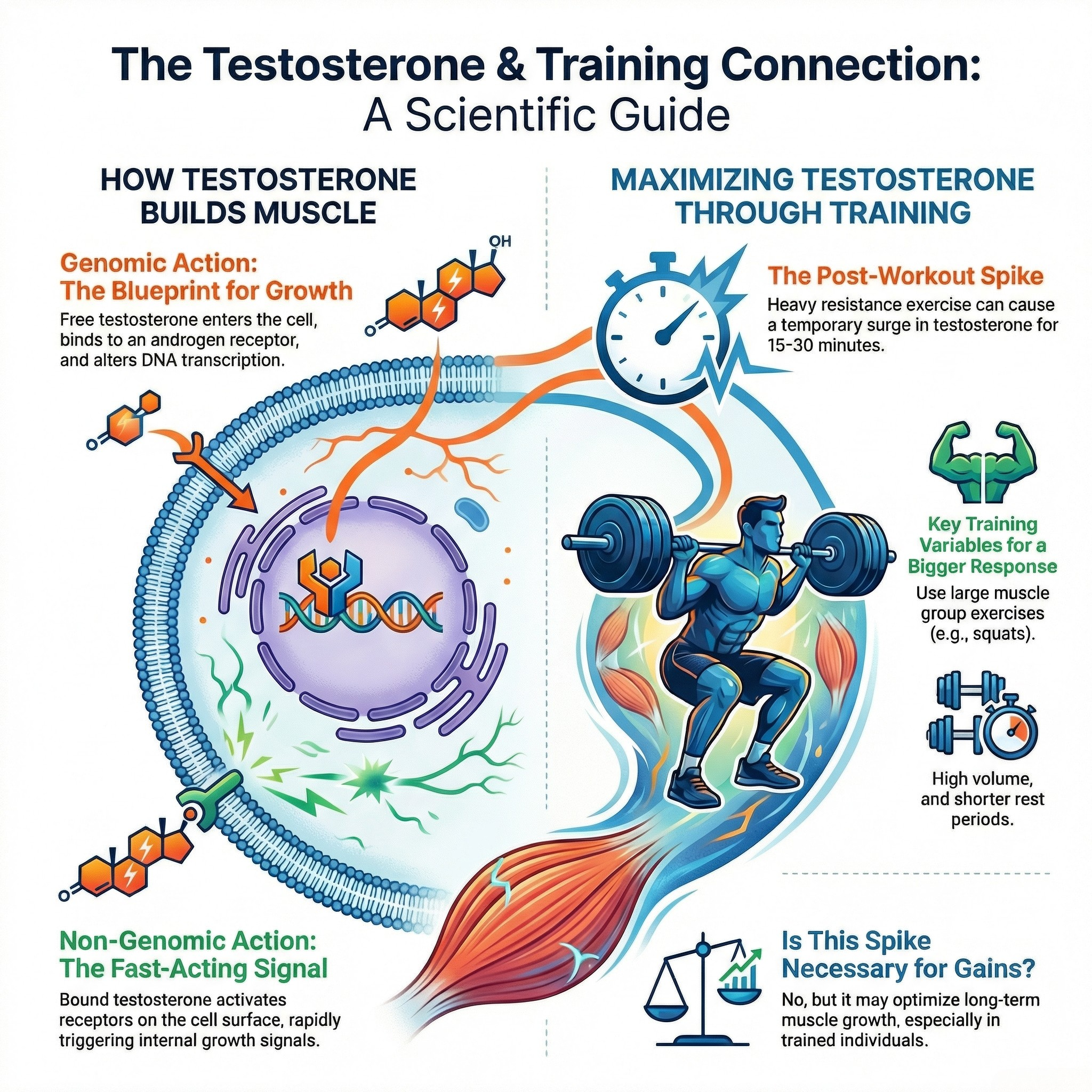
In the fitness world, testosterone is often hailed as the holy grail of muscle growth. It's the hormone that gets all the credit for building strength, increasing size, and driving performance. But while testosterone is undeniably a powerful player in our physiology, its relationship with resistance exercise is far more complex and surprising than the simple "more is better" mantra suggests.
This hormone’s role isn't just about raw levels; it's about brief signals, cellular sensitivity, and even local production within the muscle itself. This article will unpack some of the counter-intuitive truths revealed by modern exercise science and reveal how testosterone really works in response to your workouts.
1. The Post-Workout Spike Isn't a Requirement for Growth
A popular belief in strength training, often called the "hormone hypothesis," is that maximizing the acute spike of anabolic hormones like testosterone right after a workout is critical for muscle growth (hypertrophy). The logic seems sound: lift weights, boost testosterone, build muscle.
However, research directly challenges this idea. The science shows that gains in both strength and muscle size are entirely possible even without a significant, sharp rise in testosterone following exercise. According to a review in Sports Medicine, neither an acute rise in testosterone nor a long-term increase in your baseline levels is absolutely necessary to experience these gains, especially for those new to training.
This is an important and liberating concept. It suggests that athletes should focus their energy on proven training principles—like progressive overload, volume, and consistency—rather than trying to chase a fleeting hormonal response.
2. The T-Spike Is a Brief Signal, Not a Lasting Flood
When a post-workout testosterone spike does occur, it's incredibly brief. Studies show that levels typically return to baseline within just 15 to 30 minutes following exercise. So, what's the point of such a short-lived increase? The answer lies not in the duration of the spike, but in the message it sends.
A hormone is useless without a receptor to bind to. Think of testosterone as the message and the androgen receptor as the mailbox—without a mailbox, the message can't be delivered. The more critical, longer-lasting effect of a workout is the upregulation of these androgen receptors (AR) in the muscle cells. This process, where the muscle becomes more sensitive to testosterone, can continue for several hours after the workout is over.
A simple analogy helps to explain this:
The testosterone spike is like a key that briefly unlocks the muscle's potential.
The AR upregulation is the muscle "opening more doors" to become more receptive to the testosterone that is already present.
Here’s a surprising insight about nutrition: consuming a mixed meal before a workout can sometimes lead to a drop in circulating testosterone post-exercise. While this may sound counterproductive, there's crucial context. This drop in blood testosterone can coincide with a significant increase in the muscle's androgen receptor content. This suggests the hormone has done exactly what it's supposed to do: it has moved out of the bloodstream and into the muscle to get to work.
3. Your Muscles Might Be Their Own Testosterone Factories
Another fascinating area of research is the concept of "intracrinology." In simple terms, this means that certain tissues in the body, including skeletal muscle, have the ability to create their own testosterone. They can take precursors circulating in the blood, such as dehydroepiandrosterone (DHEA), and convert them into active testosterone directly within the muscle cell, without that testosterone ever entering the general circulation to be measured by a standard blood test.
The significance of this local production is profound. Consider this impactful fact from a scientific review on the topic:
When testicular synthesis is removed, circulating testosterone levels drop by 95–97%, but physical function only reduces to approximately 40%.
This remarkable finding suggests that local testosterone production within the muscle and other tissues is so significant that it can preserve a substantial amount of physical function even when the body's main T-producing engine is shut down. The fascinating implication is that the level of testosterone measured in a blood test may not be telling the whole story about the anabolic environment inside your muscles.
4. Testosterone Works in Both "Slow Mode" and "Fast Mode"
For decades, we understood testosterone's action through a single, classic mechanism. But newer research has revealed that this powerful hormone has more than one way to deliver its message.
Genomic Action ("Slow Mode") This is the traditional process we learn about in biology. Testosterone diffuses into a cell, binds to an androgen receptor, and the complex travels to the cell's nucleus. There, it influences gene expression to kickstart the synthesis of new proteins—the building blocks of muscle. Because this process involves changing gene activity, it's relatively slow, taking anywhere from 30 minutes to several hours or even days to produce a measurable effect.
Non-Genomic Action ("Fast Mode") More recently, scientists have identified a much faster pathway. In this mode, testosterone can interact with receptors on the cell membrane, triggering rapid intracellular signaling cascades without ever entering the nucleus or binding directly to DNA. This "non-genomic" action can produce a biological response within seconds.
This brings us back to that fleeting post-workout spike. If testosterone's main job takes hours or days, why would a signal that lasts only 15 to 30 minutes matter? The existence of this "fast mode" provides a compelling answer. This rapid, non-genomic pathway could be precisely why a short-lived hormonal signal is still so physiologically meaningful. It doesn't need to hang around for hours to kickstart important cellular events that set the stage for growth and recovery.
Conclusion: Beyond the Spike
The relationship between resistance training and testosterone is far more nuanced than the simple "more T equals more muscle" equation. As we've seen, building a stronger, more muscular physique is not about chasing a temporary hormonal spike.
Instead, it's an intricate process involving brief hormonal signals that increase your muscles' sensitivity, the potential for local hormone production right where it's needed, and multiple biological pathways that operate on different timelines.
So the real question isn't how to chase a fleeting hormonal signal, but how to master the fundamentals of training that create the perfect environment for all these intricate systems to do their work. Are we focusing on the momentary spike, or are we building a better receiver?
