
The Pre-Surgery Secret to a Better Prostatectomy Recovery
1.0 Introduction: Turning Waiting into Winning
For many men facing a radical prostatectomy, the waiting period before surgery is filled with anxiety. Concerns about the common side effects, primarily urinary incontinence (UI) and erectile dysfunction (ED), can be overwhelming. But what if that waiting time wasn't just a passive delay? What if it was a crucial window of opportunity to actively improve your surgical outcome?
Recent clinical research is revealing a powerful shift in thinking: from reactive, post-surgery rehabilitation to proactive, pre-surgery preparation. This article synthesizes several surprising and powerful takeaways from these studies, showing how a structured "prehabilitation" program can dramatically improve recovery, helping men regain control faster and more completely.
2.0 Takeaway 1: "Prehab" Beats Rehab — Why Starting Early is a Game-Changer
The traditional model of care for radical prostatectomy has focused on "rehabilitation"—interventions that begin after the surgery is over. However, a newer, more proactive model called "prehabilitation" is gaining significant ground. This approach uses the surgical wait time, which can range from weeks to several months, as a "unique opportunity" for patients to physically and psychologically prepare for the operation.
The core logic is simple but profound. By starting training before surgery, men can master the necessary skills while their bodies are not yet dealing with the effects of the procedure. One study articulates this advantage perfectly:
"By commencing [physiotherapist-guided pelvic floor muscle training] before [surgery], patients are well prepared and are able to understand pelvic floor muscle activation in the absence of [post-prostatectomy urinary incontinence] and pain."
This is a game-changer. It allows you to build a strong neuromuscular foundation and master the correct motor skills when you are not hindered by post-surgical pain, altered pelvic sensation, or the immediate stress of incontinence. You learn to control the right muscles before you desperately need them.
3.0 Takeaway 2: The Results Can Be Staggering
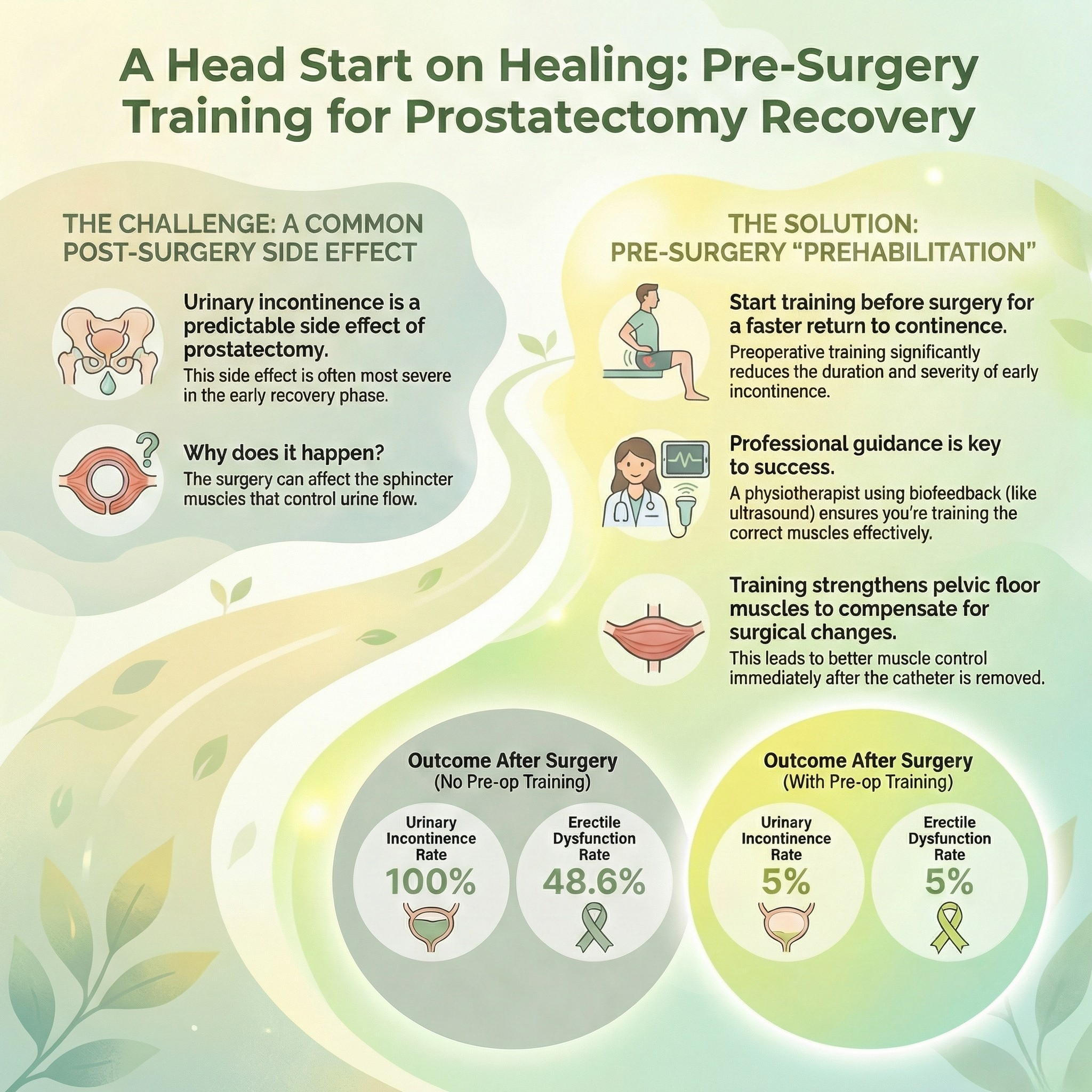
Just how effective can this pre-surgery training be? While outcomes vary, the results from some clinical trials are compelling. In a small but striking study of men undergoing traditional open prostatectomy, researchers compared a group that received preoperative training with biofeedback to a control group that did not.
This study, led by Perez et al., involved an experimental group of 20 men and a control group of 32 men. The training utilized an inflatable anal probe to provide real-time pressure feedback. The findings were dramatic:
Urinary Incontinence: The occurrence of UI was just 5% in the group that did pre-op training, compared to 100% in the control group.
Erectile Dysfunction: The occurrence of ED was also only 5% in the pre-op training group, versus 48.6% in the control group.
While these astonishing numbers come from a small study focused on a specific surgical technique, they highlight the transformative potential of a proactive approach. By preparing the body for the stress of surgery, it may be possible to significantly reduce the risk of its most common and feared complications.
4.0 Takeaway 3: This Isn't Just "Doing Kegels" — Modern Training is Different — How
Effective prehabilitation is far more sophisticated than simply being told to do "Kegel exercises" at home. Modern, evidence-based programs are structured, precise, and guided by technology, much like an athletic training regimen.
4.1 Precision Training
Researchers have discovered that different verbal instructions activate different pelvic floor muscles. Effective training isn't a blunt-force effort; it's about targeting the right muscles for the job. For example, specific cues like "shorten your penis" or "imagine you are stopping the flow of urine" have been shown to encourage improved activation of the urethral sphincter, the key muscle for maintaining urinary continence after prostatectomy.
4.2 A Real Workout Regimen
A proper prehab program is structured like a real workout. One study by Milios et al. demonstrated the benefits of a higher-intensity program. The intervention group performed a rigorous regimen of 120 contractions per day, which included both fast (1-second) and slow (10-second) contractions. In contrast, the "usual care" control group performed only 30 contractions per day. Furthermore, the high-intensity group performed all exercises in a standing posture, which better prepares the muscles for the real-life situations—like walking, lifting, or coughing—that challenge continence.
4.3 You Get Real-Time Feedback
A key component of modern training is biofeedback. Instead of just guessing if you're doing the exercise correctly, biofeedback allows you to see what’s happening in real time. Clinicians use non-invasive tools like transperineal or transabdominal ultrasound, or devices like anal pressure sensors, to display your muscle contractions on a screen. This visual feedback is invaluable, ensuring you are activating the correct muscles effectively and not compensating with other muscle groups, like the abdominals or glutes. It turns a vague instruction into a clear, measurable action.
5.0 Takeaway 4: The Biggest Gains Happen Right When You Need Them Most
While many men eventually regain good urinary control in the long term, the first few weeks and months after surgery can be the most challenging period, both physically and emotionally. This is where prehabilitation delivers its most significant quality-of-life benefits.
The primary advantage of prehab is not necessarily a better long-term outcome, but a drastically improved recovery in the crucial early phase. A key study by Patel et al. measured leakage objectively using 24-hour pad weight. The results were clear:
At 6 weeks post-surgery, the average 24-hour pad weight for the prehab group was just 8.6 grams, compared to 17.0 grams for the control group.
Crucially, the study also found that by 3 months, there was no significant difference in pad weight between the two groups. This insight reinforces the true value of prehabilitation: it significantly reduces the duration and severity of incontinence when it matters most. Returning to work, social activities, and intimacy without the constant worry and inconvenience of managing pads weeks or even months sooner is a major victory that can have a profound positive impact on a patient's overall well-being.
6.0 Conclusion: From Patient to Participant
The evidence points to a new paradigm in preparing for radical prostatectomy. The time before surgery is not a passive waiting period but a powerful training season. By engaging in a structured, physiotherapist-guided prehabilitation program, men can shift from being passive patients to active participants in their own recovery. This approach empowers you to build strength, learn crucial motor skills, and prepare your body for the challenges ahead, significantly improving your chances of a faster, better recovery.
The evidence suggests that you can train for surgery like an athlete trains for a game. If you had the opportunity, how would you use your 'pre-op' season?
