
Beyond Kegels: Surprising Truths About Men's Pelvic Health
Introduction: The Overlooked Foundation of Men's Health
For most men, the term "pelvic floor" is either unknown or dismissed as a topic relevant only to women's health. This oversight isn't just a gap in knowledge; it's a silent health crisis that leaves men suffering from highly treatable conditions like chronic pain, incontinence, and erectile dysfunction, often blaming age or anatomy when the real culprit is muscle dysfunction. The reality is that the male pelvic floor is a critical anatomical structure, fundamental to core stability, bladder control, and sexual function. This article aims to dismantle the stigma by revealing five surprising, data-backed truths that every man should know about this essential part of his body.
1. That 'Prostate Problem' Might Not Be Your Prostate at All
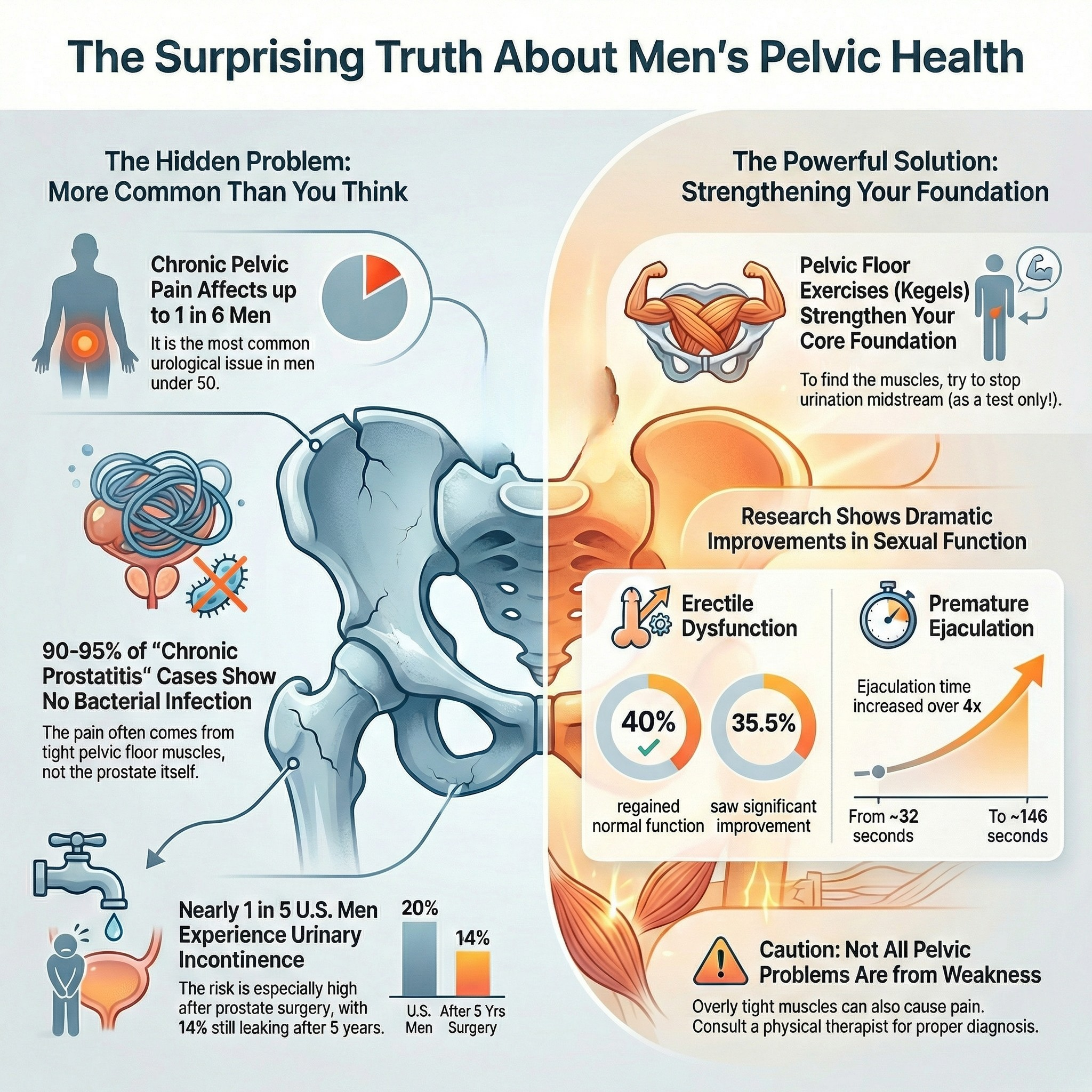
Chronic Pelvic Pain Syndrome (CP/CPPS) is the single most common urological diagnosis in men under the age of 50. For decades, persistent pelvic pain was almost universally attributed to an issue with the prostate gland and labeled "chronic prostatitis." For decades, the prostate was the default suspect for any pelvic discomfort, leading to a cycle of frustrating and ineffective treatments. The modern understanding, however, points to the muscles themselves.
A critical statistic reveals the gap in understanding: research shows that in 90% to 95% of cases of chronic pelvic pain, no bacterial infection can be identified.
For the vast majority of these men, the issue is not an infection but a neuromuscular problem. The pain often stems from overly tight and overactive (hypertonic) pelvic floor muscles. This distinction is vital, as it means repeated courses of antibiotics—a common but ineffective treatment for non-bacterial CP/CPPS—fail to address the root cause. Getting a correct diagnosis that assesses the muscles of the pelvic floor is the first step toward effective relief.
2. The Secret Engine for Better Erections and Lasting Power
The pelvic floor plays a direct and vital role in male sexual health, yet it is rarely mentioned in discussions about erectile dysfunction (ED) and premature ejaculation (PE). Specific pelvic floor muscles, namely the ischiocavernosus and bulbospongiosus, are responsible for achieving and maintaining a rigid erection by compressing veins to trap blood in the penis. When these muscles are weak or poorly coordinated, sexual function can suffer.
Fortunately, strengthening them can be transformative. A landmark clinical trial investigated the effect of a structured program of pelvic floor muscle exercises on men with ED. The results were remarkable:
A structured pelvic floor exercise program restored normal erectile function in 40% of participants, with an additional 35.5% seeing significant improvement.
Pelvic floor rehabilitation is also highly effective for treating lifelong premature ejaculation. In a study presented at the European Congress of Urology, a targeted exercise program produced stunning results. After 12 weeks, the average ejaculation time for men with lifelong PE increased more than four-fold, from 31.7 seconds to 146.2 seconds. These findings are a game-changer, establishing pelvic floor physiotherapy not as an 'alternative' treatment, but as a primary, evidence-based intervention that can resolve the underlying mechanical cause of ED—something medication alone cannot do.
3. Warning: Kegels Are Not Always the Answer (and Can Make Things Worse)
While many have heard of Kegels, few understand that they are a specific tool for a specific problem. Pelvic floor dysfunction comes in two main, opposing types, and applying the wrong solution can make symptoms worse.
Hypotonic (Weak) Pelvic Floor: The muscles are too weak and lack endurance. This can lead to issues like stress incontinence (leaking with a cough or sneeze) or erectile dysfunction. For a hypotonic pelvic floor, strengthening exercises like Kegels are appropriate.
Hypertonic (Tight) Pelvic Floor: The muscles are too tight, overactive, and have forgotten how to relax. This is often the underlying cause of chronic pelvic pain, urinary urgency, a hesitant urine stream, and painful ejaculation.
The most important takeaway is this: performing strengthening exercises like Kegels on an already tight (hypertonic) pelvic floor will only increase the tension and worsen the pain, urinary, or sexual symptoms. For a hypertonic pelvic floor, treatment must focus on relaxation and release. This is achieved through techniques like diaphragmatic (belly) breathing, specialized stretches, and manual therapy from a pelvic floor therapist. This is precisely why a professional assessment is not just beneficial, but critical. Self-treating without knowing the state of your muscles can be like putting a cast on a muscle cramp—it only makes the underlying problem worse.
4. The Scale of Male Incontinence Is Larger Than You Think
Urinary incontinence (UI), or the involuntary leakage of urine, is not a minor issue or something that only affects men after prostate surgery. It is a significant and growing problem. A comprehensive analysis of U.S. national health data revealed an alarming trend:
The prevalence of urinary incontinence among men in the USA rose from 11.5% in 2001-2002 to 19.3% by 2017-2020.
Put simply, this means that nearly one in five men now experiences some form of involuntary urine leakage. The risk factors for UI are closely linked to overall health and include age, high body mass index (BMI), smoking, and physical inactivity. This data reframes incontinence not just as a bladder problem, but as a potential indicator of broader health status.
5. Your Pelvic Floor Is a Key Player in Your Core
Think of your pelvic floor not as an isolated hammock, but as the dynamic floor of a pressurized container. It works in a coordinated team with the diaphragm (your breathing muscle) at the top, and your deep abdominal and back muscles forming the walls.
This integrated system works together to stabilize the spine and pelvis, manage pressure within the abdomen, and facilitate healthy movement.
Because these muscles are so interconnected, a problem in one area can have cascading effects. This means that your chronic low back pain, your habit of holding your breath when you lift, or even your desk posture could be direct contributors to your pelvic symptoms. It’s a crucial reminder that the body works as a whole, and the solution to a pelvic problem might start with how you breathe or stand.
Conclusion: It's Time to Talk About It
The five truths in this article dismantle a dangerous myth: that pelvic pain, leakage, and sexual dysfunction are simply things men must endure. The data shows the opposite. These are not character flaws or inevitable signs of aging; they are often symptoms of a treatable musculoskeletal issue. Understanding the true nature of these problems—whether they stem from muscle weakness, tightness, or poor coordination—is the key to unlocking effective, lasting solutions.
Now that you know your pelvic health is fundamental to your quality of life, what is one step you can take to move from awareness to action?
