
Beyond the Six-Pack: Male Body Image and Disordered Eating
The cultural shorthand for men's fitness often revolves around a single, powerful image: the pursuit of a chiseled, muscular physique. From magazine covers to movie screens, the message is clear—strength, discipline, and health are measured in visible abs and defined biceps. This ideal drives millions of men to gyms, encouraging them to lift heavier, eat cleaner, and push their physical limits. For many, this is a healthy and rewarding journey.
But for a growing number of adolescent boys and men, this path takes a darker turn. The relentless pressure to achieve an ideal body can lead to significant and often hidden physical and mental health problems. The conversation about body image has rightly focused for decades on the immense pressures placed on women and girls, but a parallel struggle affecting boys and men has been quietly intensifying. This struggle manifests in two distinct but related issues: disordered eating, which aims to decrease body size, and the pursuit of muscularity, which aims to increase it.
By examining psychological research, we uncover a hidden world of "partial syndromes," "reverse anorexia," and paradoxical risk factors that prove the crisis in male body image is far more complex and widespread than we've been led to believe.
1. The Gender Gap in Eating Disorders Is Much Narrower Than You Think
The prevailing perception is that eating disorders are overwhelmingly a female issue. This is supported by clinical statistics, which estimate that adolescent and adult males make up approximately 10% of clinically diagnosed cases. However, this figure tells only part of the story and significantly underestimates the scope of the problem.
When researchers include "partial syndrome eating disorders"—cases where individuals experience considerable psychological disturbance but do not meet the full, strict diagnostic criteria—the gender gap narrows dramatically. According to a large community sample, the female-to-male ratio for full or partial bulimia nervosa is just 2.9 to 1. For full or partial anorexia nervosa, it is even smaller, at 2.0 to 1. This is a crucial distinction because it reveals that a large number of males are suffering from significant eating-related distress that flies under the clinical radar, preventing them from being seen, diagnosed, and helped.
2. The Opposite of Anorexia: When the Obsession is Being "Too Small"
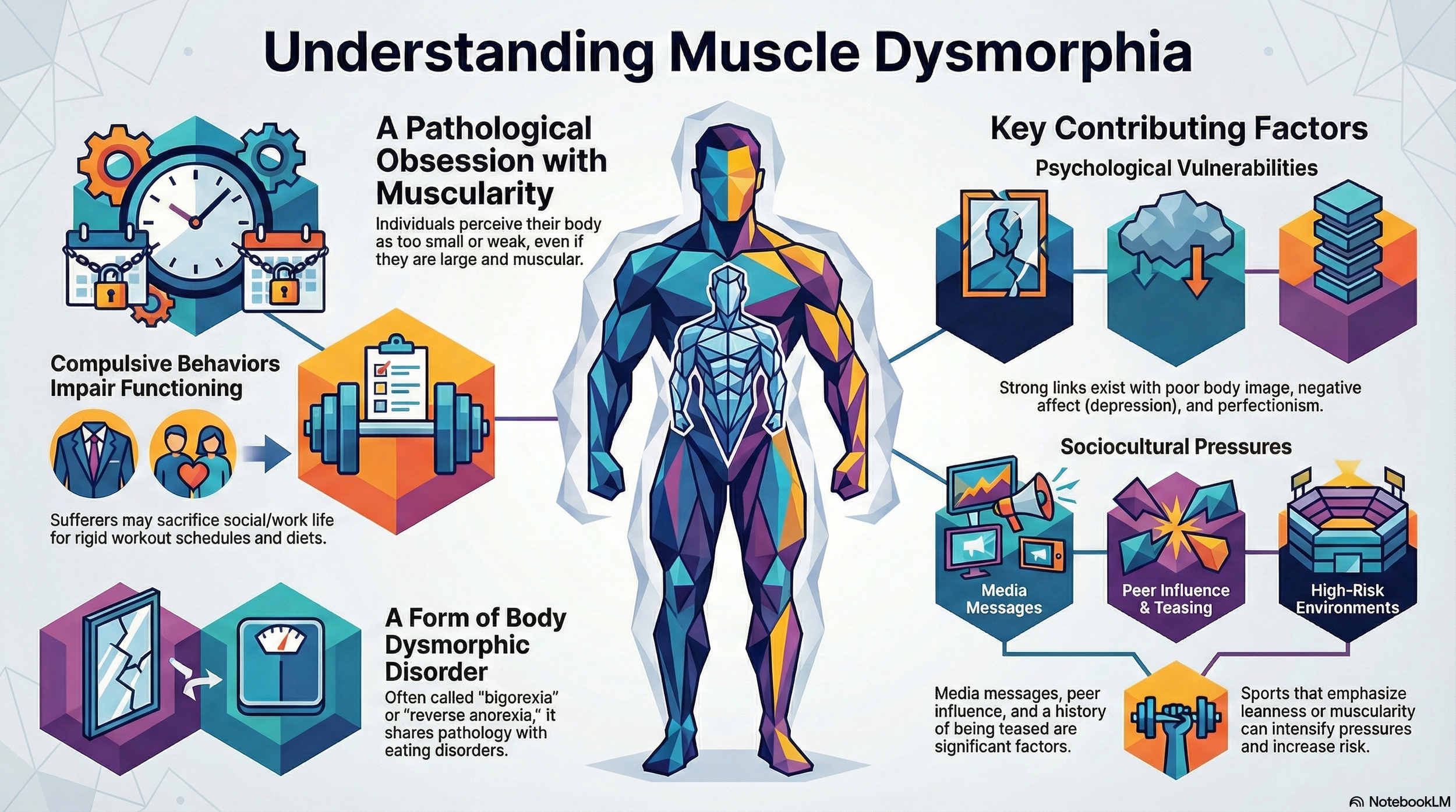
While some men develop disorders centered on a drive for thinness, a growing number are affected by an obsession that is, in many ways, the polar opposite. Known as "muscle dysmorphia" and sometimes called "reverse anorexia" or "bigorexia," this condition is a severe form of body image disturbance.
The core feature of muscle dysmorphia is a profound and distorted perception of one's own body. As researchers describe it:
"characterized by a fear of being too small, and by perceiving oneself as small and weak, even when one is actually large and muscular"
This preoccupation can lead to a range of compulsive behaviors. Individuals with muscle dysmorphia may spend hours in the gym every day, follow abnormally rigid eating patterns, squander excessive amounts of money on supplements, and avoid social situations where their body might be exposed, such as beaches or pools. Officially, muscle dysmorphia is recognized as a sub-category of body dysmorphic disorder, highlighting its classification as a serious psychological condition.
3. A Look Inside the Obsession: "I Still Hate the Way I Look"
The clinical diagnosis of muscle dysmorphia outlines the behaviors, but the internal experience reveals a relentless psychological prison. In the words of one 27-year-old bodybuilder, the obsession poisons everything from social gatherings to the most intimate moments of his life.
The obsession dictates every meal and social interaction, leading to a life of isolation:
"Bodybuilding is my life, so I make sacrifices elsewhere. I’m always thinking about the nutritional content of food and how it would affect the way I look, so I can never eat out at restaurants or go to a friend’s for dinner because it would mess up my diet."
Despite achieving a physique that most would see as exceptionally muscular, the internal perception remains one of inadequacy, affecting even the most intimate moments:
"In my mind I know I am bigger than most of the guys on the street but I still feel inadequate. I don’t like undressing in front of my girlfriend and I don’t enjoy sex because I’m too busy worrying about the way I look."
4. The Same Pressures, Different Goals
One of the most compelling findings from research is that many of the same factors that put girls at risk for eating disorders also apply to boys. A wide range of biological, psychological, and sociocultural pressures are shared between the genders, including factors like Body Mass Index (BMI), negative affect (such as depression and stress), low self-esteem, perfectionism, and perceived pressure from parents and peers.
The crucial difference lies not in the underlying pressures but in the behavioral goal they produce. While these shared risk factors often push girls and women toward an ideal of thinness, they frequently push boys and men toward an ideal of "lean muscularity." This is perhaps the most crucial finding: male body image issues are not a niche concern, but a different manifestation of the same underlying vulnerabilities that have been studied in girls for decades. The problem isn't gender-specific; the expression of it is.
5. Puberty's Paradox: A Risk Factor for Opposite Reasons
These underlying psychological pressures are so potent that they can even turn a normal biological process like puberty into a high-risk period. For boys, puberty is generally seen as a positive physical transition. They add muscle and their shoulders broaden, moving them closer to the culturally idealized male body shape. However, research reveals a surprising paradox: the timing of puberty, rather than the process itself, can be a significant risk factor for body image problems.
The findings are counter-intuitive. Late-maturing boys, who develop after most of their peers, are more likely to experience body dissatisfaction and develop exercise dependence as they strive to catch up. Conversely, early-maturing boys, who develop ahead of their peers, are more likely to adopt strategies to decrease their weight. This shows how being out of sync with one's peer group—either "too late" or "too early"—can create distinct psychological pressures that lead to unhealthy body change strategies.
6. Sports: A Double-Edged Sword for Body Image
Just as a biological process can become a source of risk, so too can a healthy activity like sports. Participation in sports often plays a dual role in the development of male body image. On one hand, it can be a powerful protective factor. General sport participation is associated with higher self-esteem and a more positive body image for boys. It promotes physical health, social connection, and a sense of competence.
On the other hand, the specific culture of certain sports can create a high-risk environment. Research identifies two main categories of risk:
Leanness-Focused Sports: Athletes in sports where leanness is emphasized for performance or aesthetics—such as running, gymnastics, and diving—are at a heightened risk for disordered eating behaviors aimed at weight loss.
Size- and Weight-Focused Sports: Athletes in sports with strict weight classifications (e.g., wrestling) or where size and power are paramount (e.g., weightlifting, football) are at an increased risk for behaviors associated with the pursuit of muscularity, including the use of anabolic steroids.
7. When Healthy Habits Become a Compulsion
There is a fine but critical line between healthy exercise and pathological behavior. When exercise crosses this line, it can become "exercise dependence," a condition defined as a compulsion to exercise despite injuries, social obligations, or other obstacles. For someone with exercise dependence, missing a workout results in significant psychological distress, such as depression, anxiety, and guilt.
Research has pinpointed a crucial distinction in motivation that separates healthy from unhealthy exercise. Exercise that is motivated by a desire to control weight is associated with disordered eating symptoms. In contrast, exercise motivated by a desire for fitness, health, or enjoyment is not. This insight provides a clear indicator for identifying when a healthy habit may be transforming into a harmful compulsion.
Conclusion: Redefining Strength
The silent crisis of male body image is more widespread, nuanced, and serious than commonly believed. Understanding its complexity is not an academic exercise; it is essential for improving mental health, challenging a toxic aspect of modern masculinity, and ultimately, saving lives. These are complex psychological problems driven by many of the same biological and social pressures that affect girls, but they manifest in the pursuit of a different, equally punishing ideal. And while researchers note that more long-term studies are needed, the evidence available today paints a clear and troubling picture.
These findings compel us to look beyond the superficial goal of the six-pack and recognize the profound psychological struggles that can accompany it. As cultural pressures on the male body intensify, how can we foster a new conversation around men's health that values well-being over a narrow and often unattainable physical ideal?
